
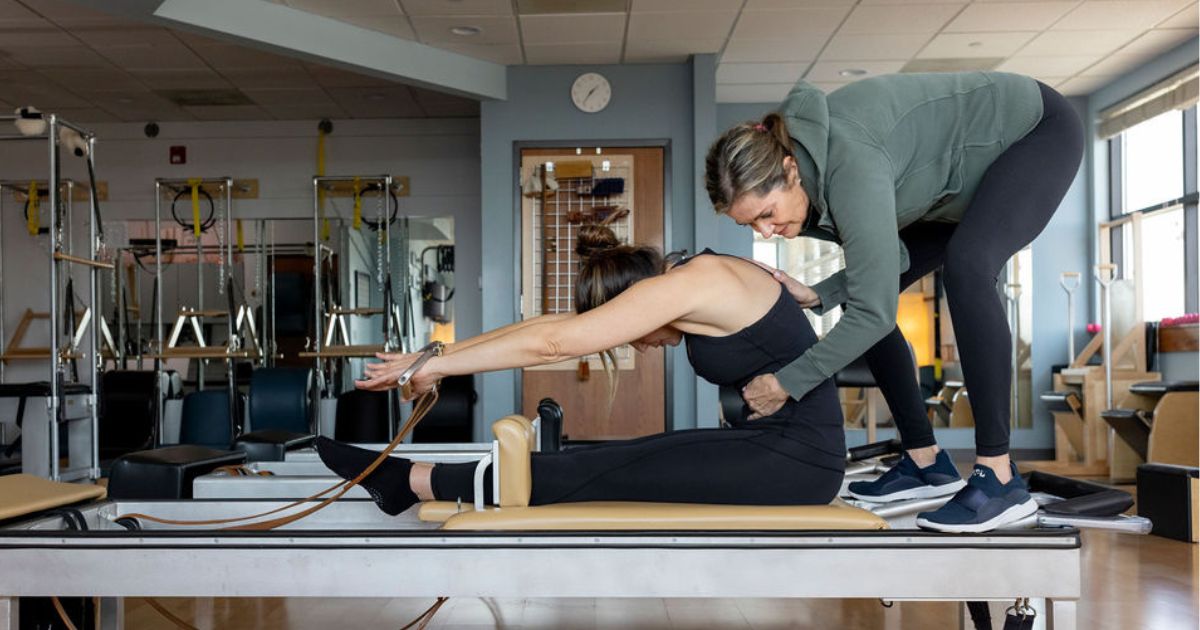
One thing I say often in the studio is that the work is on the “in.”
It’s not just about moving the carriage out – it’s about how you bring it home.
When you bring the carriage in, you’re resisting the springs. You’re controlling the movement. Your muscles are still working.
That’s where so much of the Pilates work actually lives – and where so much can be lost as well.
Sometimes I explain this using a money analogy. Let’s take Elephant on the Reformer as an example. The carriage moves out, and then it comes back in to close. Imagine you paid me $10 for this exercise.
To move the carriage out, your muscles have to work – that’s $5 right there. You had to do something to make the carriage move. But the other $5? That’s earned when you bring the carriage back in with control, using your muscles to resist the springs.
Many times – especially in the beginning – clients don’t yet understand how to resist the springs on the way in. They simply let the springs pull them home. When that happens, they’ve thrown their $5 in the trash. The work stopped halfway through the exercise. That’s like only working 50% during your entire workout.
And after all – control is the most important Pilates principle.
Romana Kryzanowska famously summarized the entire Pilates method in three words: stretch, strength, and control, with control being the most important.
There I was in Russian Splits, trying to bring my torso and arms up while keeping my hips low – a very common challenge in this exercise. I was pressing the carriage out, but not truly working the “in.” That is, until my teacher cued me to resist the carriage on the way in.
And guess what? The moment I did, I felt so much more stable. The exercise actually became easier. My body could hold its connections. Everything worked together. The work showed up where it was supposed to.
This is exactly why Pilates never gets old. Even after decades of practice, there’s always something to refine, something deeper to discover.
I’ve had many new clients come to the studio who’ve taken Pilates elsewhere and have never been taught to resist the “in.” When they do, they suddenly discover a whole new level of work – finding their muscles, staying connected, and making their bodies truly do the work instead of the springs.
That’s the depth of Pilates.
And that’s why the work is on the “in.”
Simple – but not easy.
