
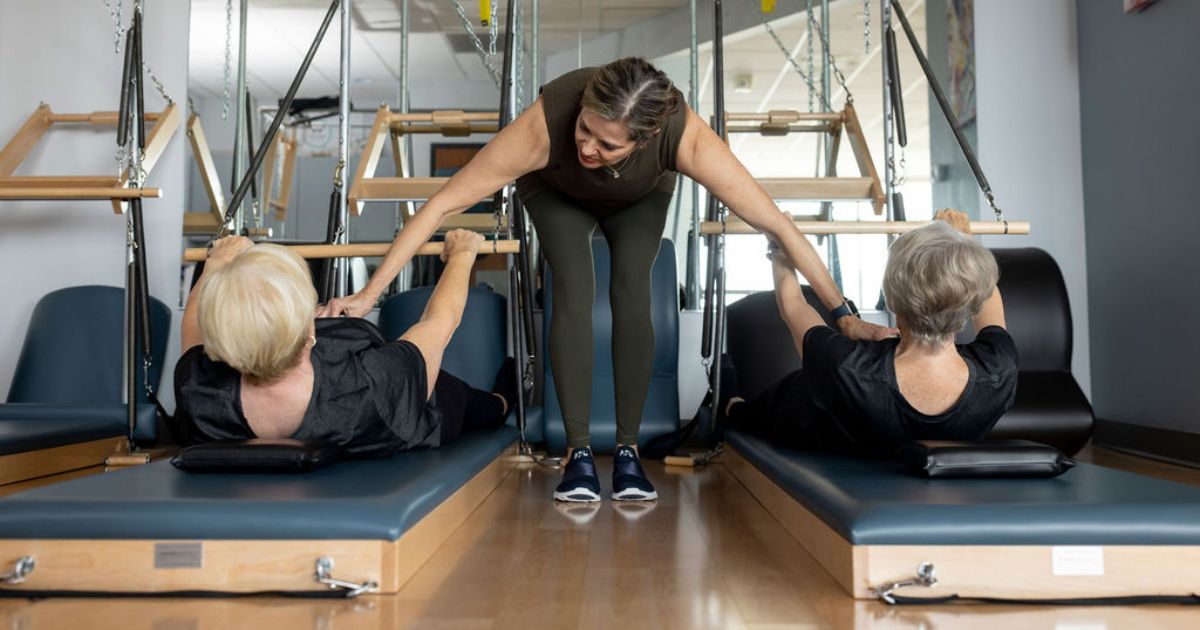
I honestly don’t remember the very first time I used the Push Through Bar.
I was a brand-new teacher, and the Cadillac I learned on wasn’t a Gratz. At the time, I didn’t know what I was missing. It wasn’t until years later, after teaching on different equipment and during my Romana’s Pilates training, that I began to understand why the Gratz Cadillac is considered the gold standard.
A few things make it stand apart: its size, its springs, and its materials. There’s more, but I’m covering these today.
The dimensions of the Cadillac matter more than people realize. My first Cadillac was more than five inches wider than a Gratz. That extra width changes the experience. The Gratz Cadillac quietly teaches you to stay organized, maintain your alignment, and work from your powerhouse rather than searching for stability.
The springs are refreshingly straightforward. Unlike many modern systems with color-coded springs, the Gratz Cadillac keeps things simple: arm springs, leg springs, Roll Back Bar springs, and Push Through Bar springs. Each has a purpose, and after a while, there’s no confusion.
Then there are the materials.
The galvanized steel pipes are smooth but not polished, and the Push Through Bar itself is made of wood rather than metal. It feels warm and secure in your hands and under your feet. There’s something reassuring about natural wood. Research even suggests that touching natural wood can promote relaxation and help calm the nervous system. Add to that the dense upholstery, which comfortably supports the spine during many Cadillac exercises, and the entire apparatus invites you to move with confidence rather than tension.
And yes, there’s also the trapeze with its springs. It sounds like something from the circus, doesn’t it?
We’ll save that for another day.
Today, it’s all about the Push Through Bar.
One of the very first things we learn in Romana’s Pilates teacher training is that the Push Through Bar deserves respect.
It requires the teacher to actively “spot” the bar, always in the beginning. If a client loses control or lets go unexpectedly, the spring-loaded bar can move with tremendous force. Safety is never an afterthought. It is built into the way we teach. We are taught where to spot the bar and the client in addition to keeping our own alignment and powerhouse strong while assisting clients.
The Push Through Bar is remarkably versatile. It can be sprung from above, below, or used without a spring. Exercises can be performed in almost every position imaginable – sitting, kneeling, standing, lying down, facing in or out of the Cadillac.
Even after years of teaching, I’m still learning new variations. That’s one of the beautiful things about the Pilates system. There is already such incredible depth within the original work that there is little need to invent something new.
One of the first exercises clients can learn using the Push Through Bar has a wonderfully honest name.
It’s simply called the Push Through.
The name tells you exactly what you’re going to do.
But doing it well is another story.
One of the biggest mistakes I see is turning the exercise into an arm and shoulder move.
Clients often lock their knees, fail to continue to move from the pelvis, hang off the bar, then push the bar down and through with their arms and shoulders, bending at the wrists and elbows. Flexible bodies often fold completely over their thighs, looking impressive while missing the purpose of the exercise entirely.
The Push Through isn’t about the arms.
It’s about the powerhouse.
Like every Pilates exercise, the movement begins from the center. As you lift the bar up, the body organizes itself into a two-way stretch, lengthening the spine in opposite directions. Then comes the deep C-curve, initiated from the low abdominals; the pelvis begins to roll back toward the mat.
Only then does the bar move.
This is the moment you make it a powerhouse move and not an arm exercise. With control, you continue to bring the waistline towards the mat and the bar comes down and through.
As you press the bar through, the abdominals continue pulling inward and upward. Even while reaching the bar away, there is an equal and opposite resistance drawing the powerhouse back.
That opposition is where the magic happens.
The spine lengthens instead of compressing.
The back body opens.
The abdominals strengthen.
Then again, I’m still learning this exercise myself.
Just last week, during one of my own private lessons, I specifically requested the Push Through. Why? Because I’m working on lifting and lengthening my upper back.
I’m tall, and years as a pharmacist – combined with raising three children – left me with a tendency to slouch. My upper back naturally wants to settle into a rounded position. For years, that posture felt perfectly normal. But Pilates has taught me something surprising: I have far more length available than I ever imagined.
As I lift the Push Through Bar overhead, that’s where my work begins. I have to find more lift from deep within my upper back rather than simply raising my arms. As I roll back into the C-curve, I keep my knees softly bent, allowing my pelvis to move freely instead of locking everything into place.
Then comes my favorite part.
As I push the bar through, I no longer collapse over my legs the way I used to. Years ago, I could easily drape myself over my thighs, but my back stayed tight and compressed. Now I lift myself up and over the bar, finding that beautiful two-way stretch through my spine.
If you know, you know.
It’s one of those moments that feels so good you almost don’t want to leave it.
Eventually, I have to. I roll my pelvis back, keep my body organized, stack my spine one vertebra at a time, and – voilà – I’m right back where I started.
The Push Through hasn’t changed.
I have.
That’s one of the greatest gifts Pilates continues to give me. The exercises don’t become more complicated. We simply become better at doing the simple things. And somehow, those simple things never stop teaching us.
