
“Slow is smooth, and smooth is fast.”
I’ve heard this phrase from several of my Pilates mentors over the years. It’s also a mindset commonly associated with military and tactical training: slow down enough to do something with control, eliminate unnecessary movement, and with practice, efficiency and speed will naturally follow.
Every time I hear it, I think: That sounds a lot like Pilates.
Slow Down
In Pilates, slower doesn’t necessarily mean easier. In fact, slowing down often makes an exercise much harder.
When we slow down, we have time to notice what we’re actually doing. Are we controlling the springs, or are the springs controlling us? Are we using momentum? Are we rushing through the difficult part of the exercise? Are we moving from the right place?
Slowing down gives us time to organize the body and focus on proper form instead of simply getting the exercise done.
Be Smooth
Once we have control, we can begin to make the movement smoother.
We want to eliminate jerky, chaotic or wasteful movement. Pilates is about economy of movement – using what we need without adding unnecessary tension or effort.
That doesn’t mean the work becomes easy. It means it becomes more efficient.
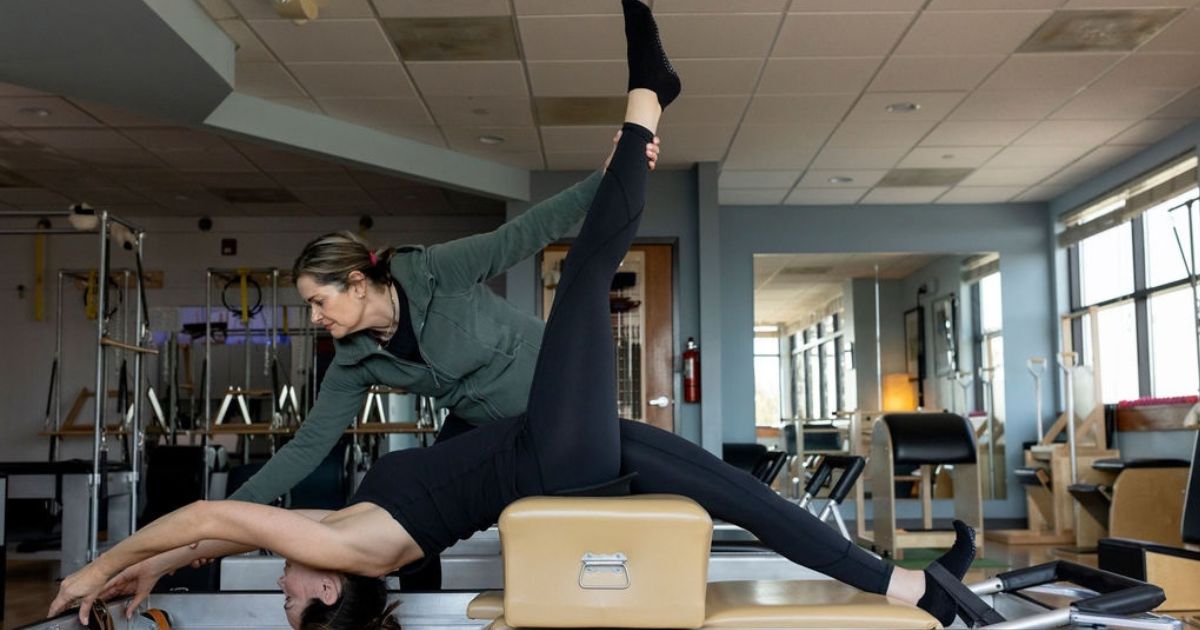
Watch an experienced Pilates practitioner and you may notice that the work often looks almost effortless. It isn’t. What you are seeing is control, concentration and precision coming together so the movement can flow.
And Then Comes “Fast”
“Fast” in this phrase isn’t really about rushing.
It’s about efficiency.
Once you understand the movement, once control is established and precision begins to become second nature, you don’t have to stop and think about every little piece. The body knows where it is going. The transitions become cleaner. The rhythm improves. The workout begins to flow.
Slow becomes smooth. Smooth becomes efficient. And efficiency allows you to move faster without becoming sloppy.
You can see this idea almost everywhere – military training, Formula 1 racing, martial arts, golf and even everyday life. The people who make difficult things look effortless usually aren’t rushing. They’ve practiced the details so many times that the details have become part of the whole.
It Takes Me Back to the Pilates Principles
The traditional Pilates principles are often described as:
Breathing. Control. Centering. Concentration. Rhythm and flow. Precision.
Of all of them, control has always stood out to me.
Romana emphasized the importance of control, and that makes perfect sense. If you don’t have control, how much do the other principles really matter?
You can’t have true precision without control. You can’t create beautiful rhythm and flow if you’re simply using momentum. Concentration is what allows you to find that control in the first place.
Joseph Pilates described his method as developing the “complete coordination of body, mind, and spirit.”
I think that is an important part of this conversation. Your body isn’t working independently of your mind. Your mind has to be present and involved in the movement.
Arnold Schwarzenegger expressed a similar idea when he said, “The mind always fails first, not the body. The secret is to make your mind work for you – not against you.”
I see this in the studio all the time. An exercise gets difficult and immediately the mind starts negotiating: I can’t do this. I’m tired. I need to stop.
Sometimes you do need to stop. But sometimes your body is capable of more than your mind is telling you.
That is where concentration and control come back into the picture. Instead of rushing through the exercise just to finish it, slow down. Concentrate. Find your center. Control the movement. Breathe. Let your mind help organize your body rather than talk you out of the work.
And something interesting begins to happen.
The more control you develop, the less you have to fight the movement. Control doesn’t mean being stiff or rigid. Greater control eventually gives you greater freedom. The movement becomes more precise, more economical and ultimately more fluid.
That’s when Pilates begins to look effortless – even though it isn’t.
Sometimes the best way to improve an exercise isn’t to add more resistance, do more repetitions or move on to something more advanced.
Sometimes you simply need to slow it down.
Find the control.
Find the precision.
Take away the unnecessary movement.
Let your mind work with your body instead of against it.
Then let it become smooth.
Because in Pilates, just like so many things in life:
Slow is smooth. Smooth is fast.
