
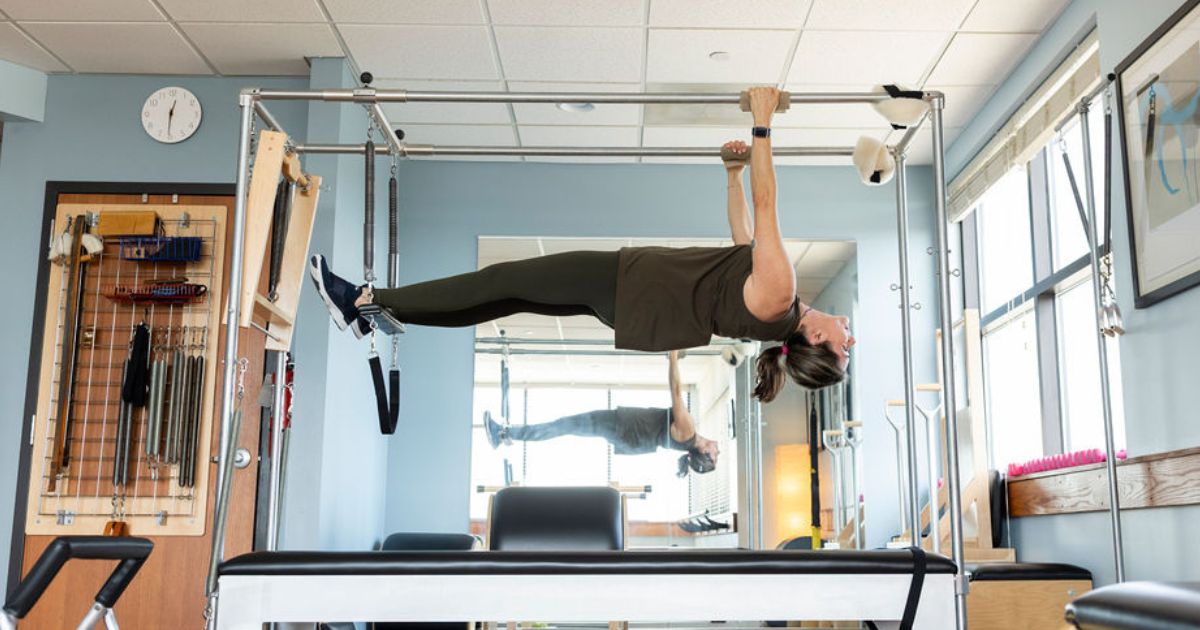
Continuing education has always been an important part of my Pilates practice and teaching. I travel several times a year to take lessons, attend workshops and seminars, and learn from teachers who have spent decades studying and teaching the Pilates method.
Sometimes continuing education means learning something new. But just as often, it means going back to something familiar and discovering there is still more to learn.
Last weekend, I traveled to Chicago for a workshop with Marjorie Orin, a Romana’s Pilates Level X Teacher. We spent two hours working through the mat using the Magic Circle.
Two hours on the mat might sound like a lot – and it was! But what made the workshop so valuable were the moments when we stopped.
Instead of simply getting through the exercises, we paused and looked at them differently. Those pauses gave us a chance to catch our breath, but more importantly, they gave us time to notice the little things.
Where could I find more length?
Could I use my breath differently?
Was I really working from my center, or was I simply doing a movement I’ve done hundreds of times before?
It is easy to become complacent with exercises we know well. Our bodies know what comes next, and before long we can find ourselves simply going through the motions. We stop being a student.
Marjorie continually encouraged us to find more length and to use our breath to help create it – to “fill the gap,” so to speak. Using the breath to draw the abdominals deeper and bring the lumbar spine toward the mat changes the exercise. Suddenly, something very familiar becomes work again.
**To me, this is what makes it Pilates.**
Otherwise, it can become just another workout. And there is nothing wrong with a workout. But Pilates is more than completing a series of exercises. It is how you perform them. It is the concentration, control, breath, precision and connection behind the movement.
This weekend, I traveled again – this time to Dallas for Romana’s Basic Seminar. It was something I had wanted to do for a while.
Back to the basics.
There is something wonderfully humbling about revisiting the same foundational work we teach every new person who walks into the studio.
We spend time on the basics for a reason. If you don’t take the time to build a solid foundation, the same problems tend to show up again and again as the work becomes more advanced.
I think of it a little like a house. You can spend all the time you want decorating the rooms, choosing beautiful furniture and adding all the finishing touches – but if the foundation underneath it is falling apart, eventually you’re going to have problems.
Pilates is much the same.
The basics teach us how to organize the body, connect to our center, use our breath, find opposition and create length. Those ideas don’t disappear when we move on to more advanced exercises. They become even more important.
That is one of the things I love most about this method. There is always another layer.
After all these years of teaching and practicing Pilates, I can return to an exercise I have done hundreds – or thousands – of times and discover something new. Sometimes it comes from a teacher’s cue. Sometimes it comes from slowing down. And sometimes it simply comes from being willing to approach something familiar as a student again.
So the next time we slow things down in the studio or go back to an exercise that feels “basic,” don’t think of it as going backward.
Think of it as an opportunity to deepen your foundation, make a new discovery, and become a student all over again.
Because sometimes the best way to move forward is to go back to the basics.
