
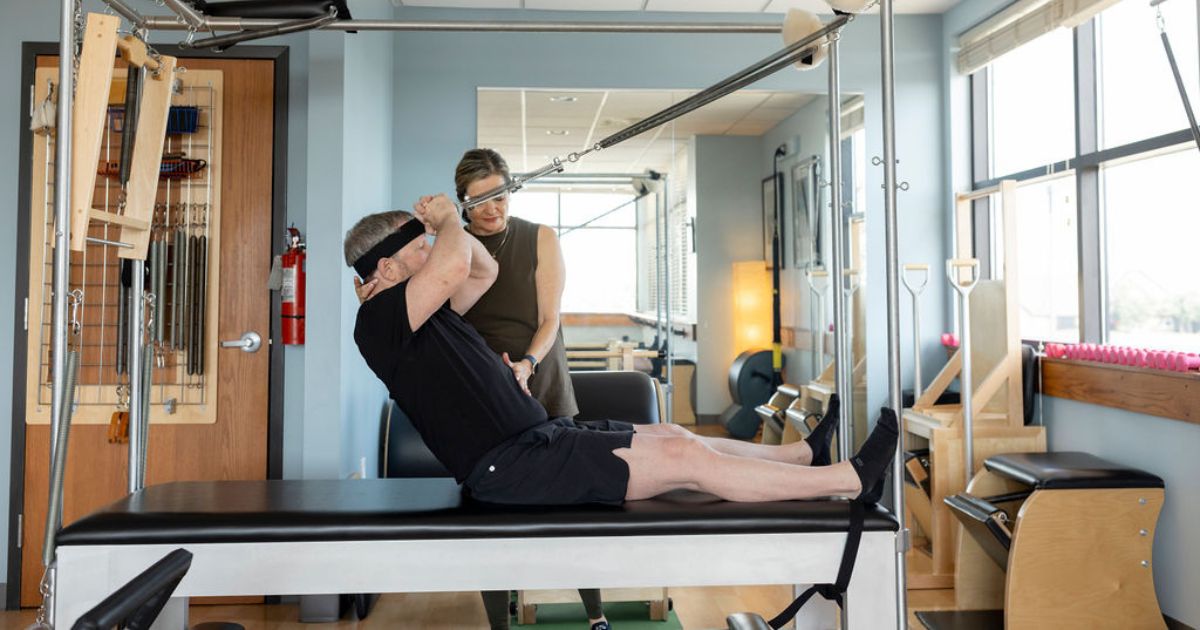
When most people think about Pilates, they think about stronger abdominals, better posture, improved flexibility, or perhaps relief from aches and pains.
And while Pilates certainly delivers all of those benefits, there’s another part of your body that loves Pilates just as much as your muscles do: your brain.
In fact, one of the reasons Pilates can feel so different from other forms of exercise is because it requires you to be fully engaged—not just physically, but mentally as well.
Joseph Pilates understood this long before scientists began studying the connection between movement and brain health. He called his method Contrology because he believed the mind should control the body. Pilates was never intended to be mindless exercise.
Pilates Demands Your Attention
Have you ever noticed how difficult it is to think about your grocery list while you’re doing Pilates?
One moment you’re thinking about keeping your shoulders down. The next, you’re pulling your abdominals in, coordinating your breathing, and reaching your arms longer while pressing your legs farther away. Suddenly, your mind has become completely occupied by the task at hand.
That’s not an accident.
Pilates asks your brain to coordinate multiple things at once. Every exercise requires concentration, body awareness, timing, balance, and control. You’re constantly receiving information from your instructor and your own body and then making adjustments in real time. Your brain is working just as hard as your muscles.
Building New Connections
Every time you learn a new movement pattern, your brain creates and strengthens neural pathways.
Think about learning to drive a car. At first, every action requires conscious effort. You have to think about the steering wheel, mirrors, pedals, and traffic all at the same time. Eventually, those actions become more natural because your brain has built stronger connections.
Pilates works in a similar way.
Many of the exercises challenge you to move your arms and legs independently, stabilize one area while another moves, or coordinate movement with breath. These tasks require your brain to communicate efficiently with your body. Over time, those connections become stronger and more refined.
It’s Not Just Exercise – It’s Practice
One of the things I love most about Pilates is that the same exercise can teach you something new every time you do it.
You might perform an exercise hundreds of times and still discover something new. One day you find a deeper connection to your center. Another day you notice how your feet are working. Another day your breathing suddenly makes more sense.
The exercise hasn’t changed.
You have.
Your awareness has improved.
This is why Pilates never becomes boring for me. There is always another layer to uncover, another connection to make, and another opportunity to learn something about how the body works.
Balance, Coordination, and Aging Well
As we get older, maintaining strength is important. But so is maintaining coordination. So is maintaining balance. So is maintaining the ability to react, adjust, and move confidently through daily life.
Pilates challenges all of these qualities at the same time.
Every Pilates exercise presents your brain with a puzzle to solve. How do you stabilize here while moving there? How do you coordinate the breath with the movement? How do you create more length while maintaining control? The answers aren’t found by working harder – they’re found by paying closer attention.
This process of observation, adjustment, and refinement is happening throughout every session. The body is moving, but the brain is actively learning. With each repetition, you develop a greater understanding of how your body works and how all the pieces connect together.
You’re not simply exercising muscles. You’re practicing movement.
And movement is one of the most important skills we can continue to develop throughout our lives.
Using All Five Parts of the Mind
Many of you have heard me talk about using the five parts of the mind during Pilates: imagination, intuition, intelligence, will, and memory.
Imagination helps us create the images and visualizations that bring an exercise to life. Intuition helps us sense when something feels right – or when something needs adjusting. Intelligence allows us to understand the purpose behind the movement and how the body is organized. Will keeps us focused when an exercise becomes challenging and encourages us to continue refining our work. Memory helps us recall the lessons from previous sessions and apply them each time we practice.
When all five parts of the mind are engaged, Pilates becomes much more than a series of exercises. It becomes a conversation between the mind and body. You begin to notice more, connect more, and move with greater purpose and control.
Your Brain Needs Exercise Too
Most people come to Pilates because they want to feel better physically. They want a stronger back, healthier hips, better posture, or more energy.
What often surprises them is how much sharper and more connected they feel mentally after a session.
They leave standing taller, moving better, and thinking more clearly.
That’s because Pilates isn’t just exercise for the body.
It’s exercise for the brain.
And just like the body, the brain benefits from being challenged, engaged, and continuously learning.
Perhaps that’s one of the reasons so many people continue practicing Pilates for years. There is always another connection to discover, another skill to refine, and another opportunity to learn something new about yourself.
Your muscles may be doing the work.
But your brain is enjoying every minute of it.
